Google spent two weeks cleaning up spam this fall. At the same time, it quietly broke the tools most of us use to measure the cleanup. That's a bit like a referee changing the rules mid-game and then unplugging the scoreboard. The September 2026 spam update finished on October 8, and the dust has mostly settled. However, the rank tracker mess it overlapped with is still going. Here is what happened, what the research says, and what we recommend before you panic over a chart.
The September 2026 spam update, by the numbers
Google announced the update on September 24 and called it "a normal spam update" for all languages and locations (Search Engine Roundtable). Normal, apparently, now means two weeks. The update wrapped up on October 8 at 4:37 a.m. ET, almost 14 days after it started (Search Engine Land).
For comparison, the three spam updates before it were sprints. The March update took about 19 and a half hours. June took two days, and August took two days and 16 hours (Search Engine Journal).
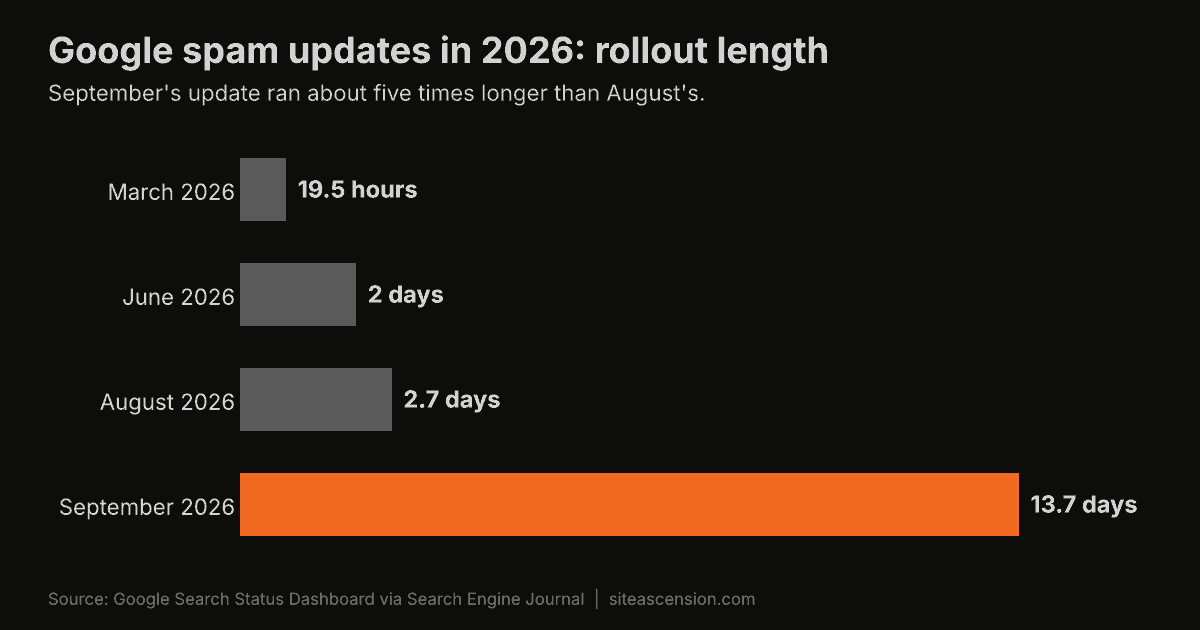
| Spam update | Started | Finished | Rollout length |
|---|---|---|---|
| September 2026 | Sep 24 | Oct 8 | About 13.7 days |
| August 2026 | Aug 18 | Aug 21 | About 2.7 days |
| June 2026 | Jun 24 | Jun 26 | About 2 days |
| March 2026 | Mar 24 | Mar 25 | About 19.5 hours |
The impact came in waves rather than one long slide. Search Engine Roundtable saw heavy movement over the weekend of September 25 to 27. Then a second wave hit on September 30 (Roundtable). Google had warned there would be several cycles, so this part at least went as advertised.
It also caps a busy year. This was the fourth spam update of 2026, while 2025 had only one (Search Engine Journal, BuildMVPFast). If it feels like Google keeps knocking on your door, that's because it does.
What Google said (and very much didn't)
Google confirmed the dates. Beyond that, the announcement was light on detail. It did not name a tactic, a policy, or a type of site as the target. It also wasn't a link spam update (Roundtable).
Barry Schwartz of Search Engine Roundtable summed up the confusion well. He questioned why a two-week rollout counts as "normal" when the last three took two days (Roundtable). Fair question. Nobody at Google has answered it.
Some results made the picture even murkier. On September 30, Roundtable noticed that Reddit's AI-translated pages were surging back. Those same pages had dropped after the May core update and the June spam update (Roundtable). A spam update that brings back machine-translated pages is not what most of us expected.
AI judging AI content
Naturally, everyone wanted to know whether this was the "AI content" update. So far, there is no official evidence that the September 2026 spam update targeted AI-generated pages specifically (Ranktracker).
Here is what we do know. Google's spam detection runs on SpamBrain, its AI-based system, so an AI is grading pages that AI often helped write. In addition, Google's policies say using AI does not make content spam on its own. Mass-producing pages mainly to rank, however, still counts as scaled content abuse (OnlineMarketing.de).
Our take is simple. Write pages a real person would want to read, and put a real person's name behind them. That held up before this update, and it held up after.
Meanwhile, the rank trackers had a terrible month
This is where things got strange. While the update rolled out, Google also got much better at blocking automated searches. Those blocks hit the scrapers that rank tracking tools depend on.
Around September 13, Nozzle's Derek Perkins told Search Engine Roundtable that most of his tool's attempts to pull Google data were blocked. He saw roughly an 80% drop in the data he could collect (Roundtable).
Then it got weirder. Several vendors reported that Google wasn't just blocking suspected scrapers. It was also feeding them bad results, which the industry now calls "poisoned SERPs." According to Roundtable's roundup, the vendors reported different amounts (Roundtable):
- Nozzle said about 8% of the results pages it collected came back poisoned.
- Ahrefs called it an industry-wide issue, with 5% to 20% of results affected depending on the data provider.
- SE Ranking said about 2% of tracked results were still affected, and that share was shrinking.
- Semrush said the poisoned results date back to late summer and that the effect on its users' rankings was limited.
Semrush later published a detailed explanation on October 27. One example is hard to forget. A search in Brazil for a stroller returned a dental supply page because both products share the word "carrinho" (TechWyse). Imagine reporting that ranking to a client.
Google has not confirmed that it serves bad results on purpose. Still, its own June 2026 guidance for SEO services is blunt. Outside tools don't have access to Google's internal ranking data, and their predictions may not come true (TechWyse).
Why this matters during a spam update
The timing could hardly be worse. A spam update is exactly when you want reliable ranking data. Instead, Glenn Gabe tracked a site that dropped during the update, and three popular tools told three different stories. Ahrefs caught the drop, Semrush showed it late, and Sistrix didn't show it at all (Roundtable).
So if your tracker showed a cliff in early October, it may have been real. It also may have been your tracker eating a poisoned results page. You can't tell from the chart alone.
What the SEO community is saying
The industry mood was a mix of frustration and dark humor. Lily Ray said rank trackers were too unreliable at the moment. Others were less polite, and one Roundtable reader said that nothing matched the real results pages (Roundtable).
The practical advice was more useful than the complaints:
- Search Console first. Daniel Skov Jacobsen noted that scraping now costs trackers more, so many sample keywords rather than check every one. He suggested reading Search Console trends before anything else.
- Spot-check by hand. Alex Wolk said checking queries in a private browser window is the only way he trusts movement right now.
- Refresh before you react. Sarah Blocksidge said SE Ranking's manual refresh helped clear up bad readings.
Notably, Schwartz believes Google's main target is AI bots and scraping services such as SerpApi, not SEO tools (Roundtable). SEO tools just happen to look a lot like those bots from Google's side.
How to check if the September 2026 spam update hit your site
The update is finished, so now is the time to diagnose. Just don't use a single rank tracker as your only witness. Here is the process we use:
- Use the bookend test. Skip the two rollout weeks, when results changed daily. Compare the 14 days before September 24 with the 14 days after October 8 (BuildMVPFast).
- Start with Search Console. Clicks and impressions come straight from Google, so they are your first-party proof. A broad drop there carries far more weight than a drop in one tool (TechWyse).
- Find the pages that lost traffic. Sort the Pages report by clicks difference. A drop on one template points at that template, while a drop across the site points at a site-wide signal.
- Rule out the usual suspects. Check for manual actions, security issues and indexing problems before you blame the update.
- Spot-check the big ones. For your most important keywords, search in a private window and see where you actually show up.
- Then review your content. Compare any losing pages against Google's spam policies, especially thin, mass-produced or near-duplicate pages.
If the bookend test shows no real change, congratulations. Your rank tracker was probably just having a bad week. Lots of them were.
How we handle updates like this
At Site Ascension, we don't report a ranking win or loss to a client based on one tool's chart. We use 3 different ranking-tracking programs, and we check tracker data against Search Console and the calls and leads the business actually gets. When the numbers disagree, we dig in before anyone changes a page.
If you're not sure whether the September 2026 spam update touched your site, start with a free SEO audit. You can also read how we approach local SEO and AI search optimization, or see our breakdown of the August 2026 spam update. And if you'd rather have a human look at your data, get in touch. We promise to check more than one tool.
